Search This Blog

Sunday, 20 March 2022

A mindful recovery from COVID, perspectives from my bedroom window, and how The Universe works in mysterious ways

Today is COVID day 9 for me and I’m still testing positive and quarantining in my bedroom. 

Thankfully I feel less shattered than this time last week, the coughing and aching has virtually stopped, I don’t feel like I’ve been flattened by a steam roller anymore, and I’ve barely needed to take any paracetamols for a couple of days.

I’m thankful to The Universe that the sun is shining, it's peaceful outside (apart from the birds singing their little hearts out, the blaring chimes of ice-cream vans, and the sounds of children laughing and playing in their garden!), and I can recover snuggled up in bed (with my laptop, phone and wi-fi!) knowing I’m being well looked after by my husband.  

Something I hadn’t expected to be able to thank The Universe for by having COVID is the gift of precious time – time to stop worrying about others for a while, and focus my energy on myself and MY recovery, for a change – ie. practice what I preach to others! 

Yes, it’s been great having time to catch up on things I’ve been meaning to do for AGES!  And I don’t just mean replying to personal emails and messages I’ve not had the energy to reply to for far too long (tick); or writing a couple of blogs (including this one - tick, tick); or burying myself in my laptop to finish projects for the Support Group I’m a Trustee of (tick, tick, tick, tick).

More importantly, I thank The Universe for offering me an insight into what life may be like for anyone with EXTREMELY impaired Executive Functioning 24/7, 365 days a year – often on top of chronic physical and mental health issues. 

By that I mean I now have a better idea of how exhausting it can be to have constant brain fuzz (more fuzzy than I usually have as someone with ADHD) that makes it not just difficult to make decisions but virtually impossible; the frustrations of trying to express verbally what I’m thinking or feeling (assuming I can remember what I was going to talk about); what it feels like to feel light-headed and keep misplacing and dropping things – and the list goes on.

I’m thankful to The Universe for giving me time to listen to what's going on outside my window, which is wide open and allowing in the wonderous smells of freshly cut grass - thanks to my lovely husband, who is also recovering from COVID, and who needed a lie down after mowing the lawn.

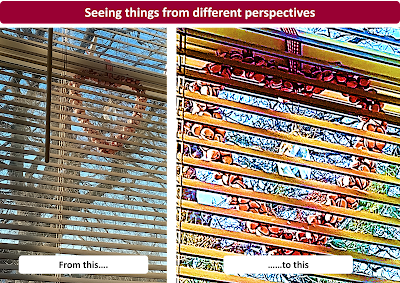
I’m thankful to The Universe for giving me time to lift my head from my laptop, lay back on my bed and enjoy watching the shadows and elliptical rainbows moving around the walls as the sun moves round and shines through the Venetian blinds and crystal pendant inside the heart hanging at the window.  

I have a tendency to see things from a different perspective from others, so I couldn't resist being a bit arty with some of photos I took. 

Great fun! 


Except…… my constantly whirring ADHD brain has also had time to consider things from a very different  perspective too.....

I think of the traumas that have made generations through the ages crave for the peace and solitude that I’m enjoying today.

And I think about the perspective of all those recovering from COVID-19 who are having very VERY different experiences to me.

For example, I think of those without a safe home to recover in, or who are in hospital, or make-shift hospitals, or lodging with others temporarily – all with an uncertain future ahead of them.

I think of all those looking out of windows with broken glass, devoid of glass, and voids where windows and walls used to be - demolished by ear-shattering blasts that rocked their once peaceful World.  

I think of looking out of windows onto landscapes that once embodied a united community, busily getting on with day-to-day life.  Except now all they see are terrifying scenes from the bleakest, most realistic CGI-enhanced war movies or virtual-reality computer games. 

I think of shattered buildings, shattered lives, shattered dreams and shattered futures that will take many, many generations of construction workers and trauma therapists to repair and rebuild. 

There are no squawking crows, chirping blackbirds or sounds of children playing for them to listen to.  Instead, they hear sirens, gunfire and explosions, and the screams of wounded innocent victims. 

No views of brightly coloured parakeets and Wood Pigeons sitting in a mighty two-hundred-year-old oak tree for them to look at from their window.  Instead, all they see is smoke from burning buildings and flashes from explosions.  In the street they see craters, barbed wire and barricades and citizens attempting to find food, water and shelter. 

If they’re unlucky they’ll see uniformed young men exhausted by prolonged resistance from what they'd been told was a colony that needed rescuing from Nazi sympathisers. 

Just how difficult must it be for the members of that youth army - and the nation they represent - to come to terms with having been duped by the President, Chiefs and Commanders who sent them there?  Power crazed leaders sitting pretty in their lavishly decorated mansions, viewing the World through blinkered lenses (based mainly on the experiences of one person’s family during WW2), being nourished by sumptuous confirmation bias being served by obedient minions who have spent decades being programmed to fear incurring the wrath of their masters instead  of looking at things from a different perspective and considering what the consequences of their actions might be on others.   

I thank The Universe for allowing me to recover from COVID,  and giving me the time to help me consider these recent events from a different perspective, and compare them to my late father’s experiences of being a victim of an horrific war that genuinely did involve Nazis.  

During WW2 he was one of 1.37 million children evacuated from London to the country.  The traumas of war affected his life, influenced his views and the decisions he made as a result – decisions that continue to affect his family 80+ years later. 

The traumas my Dad experienced during the war (now referred to as Adverse Childhood Experiences - ACEs) were nowhere near what others of his age went through, and what victims of conflict, famine, drought or injustice continue to endure today. 

My Dad was one of the lucky ones.  And so am I.  

Because what happened to my Dad has empowered me to become an instrument of change – and directly influence decisions that helps change lives. 

It never occurred to me that one day learning about ACEs and how it can seriously affect the health and wellbeing of those affected by it (especially if conditions such as PTSD aren’t quickly diagnosed and treated) might directly affect my understanding of what may have contributed to the decision my Dad made about buying his neighbour’s house when she moved, and then expanding to fit the space. 

Learning about ACEs helped me personally (for example):

  • Feel less angry about having been brought up in a chaotic home that I was embarrassed about taking people home to
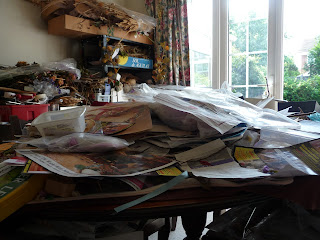
  • Feel less frustrated about my Dad’s refusal to get rid of things that most people would consider to be rubbish
  • Reconcile my frustrations at having to spend many MANY hours over two years clearing his house after he died
  • Want to understand how best to help people (like me) affected by issues related to clutter, disorganisation and hoarding behaviours
Who knew that just one person’s Adverse Childhood Experiences might one day lead me to create a whole new career for myself in 2011, leading to becoming:

  • The Marketing, PR & Partnerships Officer of The Association of Professional Declutterers & Organisers (2011 – 2013)
  • A Dementia Friend
  • A Time To Change Champion
  • The Creator of the Hoarding Ice-Breaker Form (2017) – a tool that empowers people to start a conversation if clutter, disorganisation or hoarding behaviours has affected your health
  • A Trustee of the Fastminds Adult ADHD Support Group (since 2019)
  • A trail-blazing trainer, consultant, campaigner and contributor to the acclaimed book “Understanding Hoarding” by my friend and esteemed colleague Jo Cooke of Hoarding Disorders UK CIC
  • A Member of Hoarding Working Groups:

o   The National Fire Chief’s Council (since 2013)

o   Surrey County Council (since 2017)

It just goes to show what re-framing someone’s perspectives can do!
As a result, I’ve been able to change the perspectives of and the decisions made by countless others, including clients, prospective clients, concerned relatives and friends, colleagues, Social Workers, Social Prescribers; charities, medical professionals, fire fighters, Environmental Health Officers, police officers, housing associations, solicitors, care home managers, teachers, tv production researchers, PR agencies, etc – to name but a few.

I won’t say that re-framing perspectives is always easy – far from it!  

It grieves me to learn that decisions have been made despite me pointing out the likely benefits of making a different decision, and the potential consequences of their actions - especially when it’s directly related to addressing issues related to a person’s safety, wellbeing, activities of daily living, mental health and possible reasons for their impaired Executive Functioning.

It would be lovely to think that folks will one day look back and say how grateful they were that because of me they learned to see things from a different perspective, and that the informed decisions they made as a result enabled them to live a safer, healthier and more fulfilled life as a result. 

Admittedly it’s highly unlikely the decisions I manage to influence will directly put an end to things like wars and global warming – although who knows?!

If nothing else, perhaps a few more people will regularly make time to be mindful and thank to The Universe for the little things in life that they can see and hear outside their windows - hopefully without being distracted by pandemics, war or global warming…..

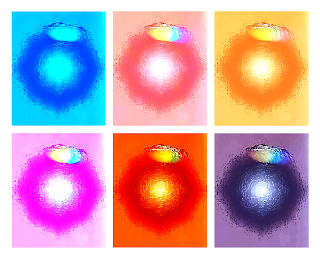
Oh, and in case you're interested, the round images above are manipulations of photos of the crystal rainbows - a most surprising perspective, thank you PowerPoint!

++++
Cherry Rudge is a Professional Hoarding Practitioner, trainer, mentor, consultant, activist, campaigner and creator of the Hoarding Icebreaker Form.

Her late father had hoarding behaviours, which is why she now specialises in working with people with hoarding behaviours and complex needs.

For further information please contact Cherry Rudge - Phone/Text: 07931 303310 - Email: cherry@rainbowred.co.uk

Saturday, 19 March 2022

Time to change the understanding about Neurodiversity amongst medical professionals

The March 2022 issue of "The Psychologist" magazine featured a BRILLIANT article entitled "Neurodiversity is not just for those we work with".

It was written by British Psychologist Joshua Muggleton (who is Autistic) and 33 other Neurodivergent (people with Neurodiverse conditions) colleagues, who drew attention to the negative affect that ineptitude can have on both professionals and patients.

Muggleton et al gave examples of how they'd been poorly treated by some colleagues upon discovering that they were Neurodivergent, and how it had affected their own mental health.   

I suspect this may perhaps be the first time (to my knowledge) that Neurodivergent medical professionals in the UK have aired their views so publicly directly to colleagues within their own profession, as the magazine is published by the British Psychological Society (BPS).

I wholeheartedly applaud and support Muggleton and the other authors of the article for "unmasking" themselves publicly, and diplomatically and unpretentiously laying down the gauntlet for the BPS to transform its attitude towards Neurodiversity in general.

Because many people with hidden disabilities encounter these types of issues - for some it can be easier (and require less energy) to mask who we are than be honest and transparent with our employer...

Regular followers of Rainbow Red (my company) and the Hoarding Icebreaker Form (that I created) will know that I’ve said on numerous occasions how I’ve come across many people with Executive Dysfunction who have issues related to clutter, disorganisation and hoarding behaviours who have been let down or abused by professionals - not just psychologists, and not just medical professionals.

Even now, in the 21st century, far too many of the most vulnerable members of our society are still being abused by or allowed to slip through "the system".  

Some may be diagnosed with (and potentially prescribed medication and/or therapy for) mental health conditions they don't actually have - most commonly the one with possibly the worst name:  Emotionally Unstable Personality Disorder (EUPD), also knowns as Borderline Personality Disorder (BPD).

Whereas conditions such as Autism and/or ADHD (co-morbidity is common) are far more likely to have explained the underlying root causes of a person's anxiety, and often some of the surprising - and what some might say are irrational - lifestyle choices they may have made along the way.  

Individuals with hidden disabilities are unfortunately vulnerable to abuse, manipulation and exploitation, and serious mis-treatment and/or abuse by (so-called) professionals happens far too frequently.

Some (like me) may not be granted shared care by their GP once they've receive a private diagnosis (because it wasn't done by the NHS), and end up paying hundreds of pounds a year for prescription medication whilst waiting years for an NHS diagnosis because of the ever-increasing waiting lists.  

Tragically, some might be victims of adverse childhood experiences (ACEs) or other traumas.  How many exactly we will probably never know.  Nor will we ever know how many went undiagnosed or felt so violated, unsupported, and broken that they chose to end their misery by taking their own lives.

In the case of Joshua and his Neurodiverse colleagues , had all medical professionals (not just psychologists) received more in-depth training about impaired Executive Functioning and Neurodevelopmental conditions (which now includes Long COVID), there would have been:

  • a far greater chance of them being diagnosed, treated and receiving appropriate support and reasonable adjustments/ adaptations as children, instead of as adults
  • a reduced risk of being stigmatised and bullied (especially as children/teenagers), leading to low-esteem issues and having to try and mask their symptoms in order to fit in
  • a far greater chance of them being offered reasonable adjustments by their employers, and applauded by them (plus colleagues, employees and clients) for the special insight they have into the types of difficulties experienced by others with hidden disabilities
  • far greater likelihood that they'd develop a stronger connection with their Neurodiverse clients, and achieve quicker, longer lasting outcomes for them as a result

In most cases, professionals genuinely believe they are doing the right thing in order to improve a person’s quality of life.  

However, they – like everyone else – are restricted by the training they have received.  Training that is flawed, inadequate, out-dated or recommends obsolete best practices that don't take into consideration people the challenges associated with activities of daily living experienced by people with impaired Executive Functioning and Neurodiverse conditions, and are proven to have done more harm than good.  

All of which begs some fundamental questions for BPS and other medical bodies responsible for training future generations:

  • How long will it be before ALL professional medical bodies (not just the BPS) make in-depth customer-focused training  about Executive Functioning and Neurodiversity part of the core curriculum?
  • How long will it be before Neurodiverse individuals can feel confident that their health and care needs will be  met (promptly and appropriately) by legitimate law-abiding professionals who have a good understanding of Neurodiverse conditions and the types of reasonable adjustments required to accommodate individuals with hidden disabilities?
  • How long will it be before Neurodiversity is being discussed in the way that mental health is now, thanks to fantastic campaigns such as Time to Change and The Royal Foundation?  It took about 10 years for the Time to Change campaign to really make an impact, let's hope conversations about Neurodiversity are common-place a lot quicker than that....
  • How long will it be before ALL public and professional organisations (including schools, hospitals, solicitors, etc)  catch up with some of the most famous IT companies in the World and recognise that employing individuals with Neurodiverse conditions such as ADHD and Autism HAS to be part of their future if it's to be sustainable.
  • How long will it be before discussions about the potential need for reasonable adjustments become an integral part of an induction process for new staff?
    • How long will it be before hospitals, care homes and nursing homes revise their business models and strategies so that ALL medical and care facilities are specifically designed to meet the needs of our aging Neurodivergent population?
    • How long will it be before we see and hear media and social media coverage damning organisations that DON'T embrace Neurodiversity?

    THANK YOU Joshua et al for giving the BPS (and the World) an insight into what success could/should look like for Neurodivergent medical professionals.  

    Now is the time for the leadership and training teams at BPS and ALL the other professional bodies (not just medical ones) to stop avoiding the elephants in the room and:

    • accept that Neurodevelopmental conditions are not going away (they're genetic), and that making people with hidden disabilities fit in with out-dated broken processes and environments that are too overwhelming for them doesn't work - it makes things worse. 
    • make people like Muggleton et al and myself (ie. people with ADHD and/or Autism etc) part of the process of change.

    It's the common-sense, best-practice, customer-focused way to run a sustainable business.  

    So please BPS and other professional organisations responsible for training future generations - please take the hint that Muggleton et al have given you, and start re-training mental health professionals to become specialists in Neurodiverse conditions instead. 

    Start creating processes and environments that are Neurodivergent friendly, not Neurodiverse minefields.  

    An empowered workforce is generally more productive, more energised, more dedicated and healthier - all of which has a direct effect on the local communities around them, and the nation. 

    With staff needing less time off work due to less work-related stress, people will need fewer appointments with health professionals, and psychologists and other professionals who haven't embraced Neurodiversity will end up out of work!

    Let's watch this space with interest and see how long it takes.....

    +++++
    Cherry Rudge is a Professional Hoarding Practitioner, trainer, mentor, consultant, activist, campaigner and creator of the Hoarding Icebreaker Form.

    Her late father had hoarding behaviours, which is why she now specialises in working with people with hoarding behaviours and complex needs.

    She has been:

    For further information please contact Cherry Rudge - Phone/Text: 07931 303310 - Email: cherry@rainbowred.co.uk


    Monday, 6 September 2021

    Sarah Harding (Girls Aloud) had ADHD and died from breast cancer

    Yesterday's news about the death of the British singer/actress/celebrity Sarah Harding is all over the front pages of today's UK newspapers.

    Sarah sadly lost her life to breast cancer, aged just 39 years old.

    She had been a member of the hugely successful British/Irish girl band Girls Aloud (which sold over 4.3 million singles and 4 million albums sold in the UK alone between 2002 and 2012); went on to have a successful career as a solo artist, actor, model, tv presenter and winner of the tv show Big Brother in 2017.  

    Her autobiography "Hear Me Out" was published in March 2021, only a few months before her death, when she knew her cancer was terminal.

    Before yesterday I admit to knowing nothing whatsoever about Sarah, except that she was famous.  So I was intrigued by the media coverage about her which revealed a fascinating, energetic character whose rollercoaster life and career screamed out at me that she was probably Neurodiverse.

    So I did some online research, and sure enough, discovered that she was indeed diagnosed with ADHD as a child.  Which made total sense when I read interviews where she'd admitted things like:

    • She eventually dropped out of school, having attended seven different ones
    • She'd had multiple jobs, including waiting tables at Pizza Hut, van driver, debt collector and as a BT operator - while performing in clubs and pubs in the evenings
    • ‘I might come across as confident when I’m out or onstage, but that’s my mask. When I’m around people you can’t shut me up; I’m a people person and I love to talk’
    • "I'm very hyper, I’ve got a low attention span, I’m a control freak and I definitely have a bit of OCD, too." 
    • She'd experienced alcohol dependency and depression over the years
    • “I’m the rock chick, blonde bombshell, party girl, the caner of the band”.
    • She didn't take medication for her ADHD until she joined Girls Aloud and began struggling with the pressures of fame
    • "Somewhere - amongst the nightclubs, the frocks and hairdos, the big chart hits, and the glamour of being a popstar - the other Sarah Harding got utterly lost. She's the one who's been forgotten". 

    Unfortunately, as with many other ADHD-ers, it’s likely that Sarah’s need for stimulation from others and impaired Executive Functioning meant that she neglected her own health and wellbeing (she probably self-medicated with alcohol as a coping strategy), and didn’t take action to address symptoms that could have indicated symptoms of a life-threatening condition until it was too late....

    In my research I found various articles in which Sarah Harding admitted that she had dismissed a lump on her breast as a cyst during the pandemic in 2020, disguising her "denial" as COVID fear and concern for overrun hospitals.

    In Sarah's autobiography "Hear Me Out", she wrote: 

    "At first I thought it was just a cyst. The trouble was the pain was getting worse.  It got so bad that I couldn’t sleep in a bed. Eventually my skin started to bruise. By now I was terrified.

    “One day I woke up realising I’d been in denial. Yes there was a pandemic but it was almost as if I’d been using that as an excuse not to face up to the fact that something was very wrong.”

    It was only when Sarah's skin began to bruise that she sought medical help.  Unfortunately, her lungs and kidneys were already failing and she was rushed to intensive care after a port fitted into her chest led to sepsis.  Doctors put her in a medically induced coma for two weeks, followed by chemotherapy and a mastectomy.

    I urge organisations that treat and support those affected by cancer to take the opportunity of Sarah’s sad passing to target Neurodiverse communities and raise awareness of the importance of regularly checking your breasts and taking action as soon as possible if there are irregularities.

    Meanwhile, one article about Sarah (which was published in The Guardian Newspaper only a few hours after the announcement of her death) really struck me more than all the others.  

    It was written by Michael Cragg, a music writer for the Guardian and Observer, and Editor of BEAT magazine, who included the phrase "....she suffered from undiagnosed ADHD as a child.....".

    Which gave me a great idea that I’m going to suggest to Mr Cragg. 

    Sadly, as Sarah is no longer around for him to ask her what this statement means to her, perhaps he might like to consider interviewing other performers who have been diagnosed with ADHD, and write articles about their views on how they might be able to relate to his statement about how Sarah "suffered from undiagnosed ADHD as a child", and what eventually getting a diagnosis meant to them, and how they live with the condition now. 

    For example, for ADHD how about interviewing Dave Grohl (Nirvana, the Foo Fighters), Will.i.am, Mel B, Steven Tyler (Aerosmith front-man), Ozzy Ozbourne (who also has Dyslexia) or Justin Timberlake. 

    And then perhaps other famous music industry icons too, who have been diagnosed with other Neurodevelopmental conditions such as:

    • Dyslexia - Mick Fleetwood, Noel Gallagher, Jewel, Carly Simon, Sir Richard Barnson
    • Dyspraxia - Florence Welch, of Florence +The Machine
    • Autism - David Byrne, lead singer of Talking Heads; Gary Numan

    Maybe also ask them about their own experiences of being affected by cancer, addictions or mental ill-health while you’re at it Mr Cragg? 

    Before it’s too late, like it was for Sarah and countless other performers…

    #ADHD #cancer #SarahHarding #GirlsAloud #mentalhealth #chronicdisorganisation #ExecutiveDysfunction #Neurodiversity #stopthestigma #breastcancer #music #celebrity #bigbrother

    + + + + +

    Cherry Rudge is a Professional Hoarding Practitioner, trainer, mentor, mentor, consultant, activist, campaigner and creator of the Hoarding Icebreaker Form.

    Her late father had hoarding behaviours, which is why she now specialises in working with people with hoarding behaviours and complex needs.

    She has been a:

    For further information please contact Cherry Rudge - Phone/Text: 07931 303310 - Email: cherry@rainbowred.co.uk

    Wednesday, 19 August 2020

    Clutter & disorganisation crisis looming for brain-damaged COVID-19 patients?

    There's potentially some good news on its way for experienced Professional Organisers and Professional Hoarding Practitioners who work with people with complex needs - we're likely to be even more in demand as a result of COVID-19.

    According to an article in The Guardian on 8th July 2020, UK neurologists have published details of mildly affected or recovering Covid-19 patients having serious or potentially fatal brain conditions.


    The cases (published in the journal Brain) support a paper recently published in The Journal of Alzheimer's Disease (by an American team of leading neurological experts), which says that some former COVID-19 patients may go on to develop cognitive decline, attention deficit, brain fog, or Alzheimer's disease.  

    And that of course means they may (for example):
    • Be left with degenerative COVID-19 related physical health problems that affect them for the rest of their lives
    • End up with PTSD caused by the trauma of having had COVID-19, as well as having to adjust to having physical anxiety, depression or stress-related illness that they may not have had before
    • Find it difficult to maintain their pre-COVID-19 career/employment status, level of income and lifestyle
    • End up finding themselves reliant on the benefits system to be able to pay their bills - assuming there is an appropriate welfare system in place where they live of course...
    • Need to downsize or request council accommodation if their situation becomes too dire (they may even have to relocate to other areas if there's insufficient suitable accommodation available in their area.
    • Lose some of their Executive Functioning (EF) - the daily skills of life that enable us to carry out what "neurotypicals" take for granted, such as:
      • the ability to remember were they put things; 
      • arrive at appointments on time (assuming they remembered to write the appointment in their diary in the first place - assuming they could even find their diary or remembered to look in their diary); 
      • organise their homes (eg. create and maintain effective filing systems for paperwork, photos, emails, etc; 
      • manage their affairs (eg. pay bills on time, arrange repairs to be carried out to fix broken heating, etc)
      • maintain a clean, safe, hygienic and clutter-free living environment
    Not that these are good things of course - absolutely not - far from it!  

    Life-changing experiences like these can be frustrating, exhausting, depressing, and time-consuming to address.  Especially for individuals who were previously physically active, focussed on career development and fiercely independent.  

    And then there's the friends and families who end up becoming carers to them post-COVID.

    Without appropriate and timely support, the health and wellbeing of people affected by these kinds of difficulties can rapidly deteriorate, and the consequences can be disastrous.
    It's only in the last few years that some local authorities (especially those that have received specialist training from organisations such as Hoarding Disorders UK CIC, Clouds End CIC and Rainbow Red) have begun to understand that issues related to clutter, disorganisation, self-neglect and hoarding behaviours are:
    • Very rarely lifestyle choices
      • Until COVID-19, the chances are that that individuals experiencing these issues had underlying neurological and/or mental health conditions (often undiagnosed).  Post-COVID-19, the difficulties could be related to that issues caused by the Coronavirus, on top of existing problems.
    • Likely to be physical representations of the chaos and overwhelm in a person's life
    • Often made worse by sending in a clearance/cleaning firm, instead of someone who offers a person-centred service
    So, why does this mean there's potentially a clutter and disorganisation crisis looming?
    Because the bad news is that:
    1. there may be no money to pay for these essential services
    2. There aren't enough of us with sufficient skills and experience of working with people with complex needs to meet demand.  And those of us who do have been inundated with calls since lockdown started - we simply can't keep up (so apologies to all those who we've not yet had a chance to contact).

    Health and social care services are likely to be overwhelmed with requests for support from the likes of professionals such as Occupational Therapists, Physiotherapists, support workers, mental health specialists and neurological specialists - all collaborating with Professional Organisers and Professional Hoarding Practitioners - empowering individuals to remain independent for as long as possible.

    We predict there could be (for example):
    • inadequate budgeting and training of NHS and local authority personnel to provide specialist person-centred practical support
    • Many people who lose their job due to the deterioration in their health, and who turn to already over-stretched health and social care and/or benefits systems to pay for support
    • enormous competition for already very limited health and social care budgets 
    • an increase in demand for council accommodation
    • an increase in the number of social workers required to deal with increased case-loads
    • an increase in safety issues in the home due to self-neglect, fires; slips, trips and falls; infestations, etc. 
    • an increase in the number of vulnerable people being targeted by unscrupulous scammers and and becoming victims of of cuckooing (when people are unwell they are less able to maintain their properties in which drug dealers take over the home of a vulnerable person in order to use it as a base for county lines drug trafficking. 

    All of which could continue for many years to come.

    Still, it's reassuring to know that decluttering and organising specialists are likely to at last become an integral part of multi-agency responses and interventions.  Better late than never.

    My hope is that by re-training people who have struggled with organising issues the past - and either attended hoarding or clutter support groups or worked with professional practitioners (or both) to develop sustainable coping strategies that  brings order to their lives - we'll end up with a new generation of practitioners as passionate as we are about giving something back to clients who were once like them.

    So, if you'd like to know more about attending training to become a Professional Hoarding Practitioner, please please please get in touch.  

    Because without your empathy, patience, and ability to motivate, empower and coach people to believe in their ability to take control of their paperwork and their homes, some people won't be able to sort their way out of their mess - which wasn't their fault in the first place....

    +++++

    To find a Professional Organiser in the UK, check out The Association of Professional Declutterers & Organisers (APDO) website - www.apdo.co.uk


    Tuesday, 28 July 2020

    Families need support too

    Client testimonials are always very much appreciated, and this one 
    - from a lovely lady who contacted me for advice because she was concerned about her mother - absolutely made my day!

    "I contacted Cherry during lock down due to my mother being taken extremely unwell. We received a phone call from the paramedic who attended to my mother, who had a very frank conversation as to how bad our mum's home was. He stated that in the future they may not be able to attend to her address due the appalling house condition. Mum's prospects at this time was very uncertain and even if she was to survive, then she couldn't return home due to her health and the home conditions.  

    What the paramedic wasn't aware of was the years/ decades of battling we have had to try to get her to resolve the issue. It came to a point where her adult children had to choose not to go to her house because it was so upsetting. It was not through not trying, I have lost count how many times we have been to her house to try help get it into a habitable state or encouraged her to access service to support her in doing so, but due to her such poor self esteem, confidence and not wanting to lose any of her possessions this just wasn't achievable.  This life changing event forced our hand to face up to the situation and get professional help. This is where Cherry came into our lives.....


    I called Cherry in March, as a stuttering, bumbling mess on the phone. Feeling helpless, bewildered, hopeless and most of all embarrassed. Cherry was absolutely amazing, she reassured, listened, empathised, had a complete understanding and most importantly made me feel supported and there could be a way forward. Cherry wasn't able to take on our mum as a client but she could hear my desperation and  promised she would look into it to see if she could find another professional to support her. Cherry supported myself and my sister via phone calls and emails. My sister suffers anxiety and had baby twins to contend with. I have a young family and working full time in a very stressful and demanding job. Cherry was completely understanding and worked around us. 


    Cherry was able to connect us to Simon who is also a professional de-clutter and hoarder supporter. We managed to persuade our mum to meet Cherry and Simon via a video link. They offered her understanding, encouragement and strategies to encourage her to start making small steps forward. Sadly our mum didn't agree to work with Simon, we believe this because she has had a difficult life which she had little control and she wants to be in charge of her decisions now. However from their conversation it has spurred our mum on to start making the changes she so desperately needs to make. When she was fitter enough, she returned home and has started to clear the kitchen, bathroom and bedroom, fingers crossed she can continue.


     I truly wish she had made the better choice of working with Simon. Myself and my brother and sister believe that this would have changed her life as it's not a straight cut solution of clearing a house, she would absolutely have benefited from the confidence and self esteem that would have come from Simon and Cherry's support. 


    My family wants to whole heartily thank Cherry and Simon for there support through one of the toughest times". 

     Which just goes to show, it's not about the stuff, 

    it's always about the people!

    Finally, I must say a big thank you to my APDO colleague Simon Wigzell of 
    Let's Get It Sorted for the calm and reassuring way he supported the family 
    - and me!

    Sunday, 28 June 2020

    Is it Depression, or is it more likely to be ADHD?


    Here at Rainbow Red we regularly meet, hear from or hear about SO many people with issues related to clutter, disorganisation or hoarding behaviours who have been diagnosed with Depression.


    We also recognise oh SO many symptoms of ADHD in those same people, and suspect that were inadequately diagnosed originally.  

    Sadly, whilst a GP rarely has the time to thoroughly assess a patient who presents with depression symptoms, they do have time to prescribed antidepressant medication.

    Had their patient been asked probing questions about what they find depressing about their life, the root cause may well have been because they were overwhelmed by life events (such as bereavements, bullying, issues at work), and struggling to cope with the everyday practical priorities like children, housework and relationships, losing weight, health problems, the washing machine breaking down ..... the list goes on, and on...

    Instead of being prescribed antidepressants or bog standard Cognitive Behaviour Therapy (CBT), a combination of ADHD medication, appropriate therapy (sometimes), support (probably from peer-led Support Groups run by people with similar issues) and educating them about practical holistic strategies that help people who experience Executive Dysfunction could have have been far more effective than antidepressants - and at the same time, potentially saved a fortune in hidden costs to taxpayers (from interventions by the emergency services, healthcare, law enforcement, benefits and social care) - not to mention probably saving lives by preventing accidents from fires in the home, or reckless driving.

    Receiving the correct diagnosis and treatment could potentially have enabled them to avoid (or at least reduce) many years of (for example):

    • regularly losing things (like keys, phone, wallet….)
    • impulsively purchasing, acquiring or accumulating non-essential items (and not being able to let go of them – even when they caused issues with their landlord or family members, or resulted in slips, trips, falls or even fires
    • turning up late to appointments, or forgetting to go to appointments
    • finding it difficult to plan or organise their homes or their lives effectively so they felt in control of their affairs
    • being easily overwhelmed or overly emotional
    • making unwise or inappropriate decisions that lead to relationship breakdowns, run-ins with the law, accidents (eg. because of reckless driving)
    • unrewarding career choices, employment tribunals and/or losing their job
    • excessive reliance on stimulants – including drugs, alcohol, food, exercise, extreme sports, etc
    • health issues due to exhaustion (eg. Chronic Fatigue Syndrome or Fibromyalgia) or unhealthy lifestyles (eg. Diabetes)
    • not fully achieving their true potential
    So if you know someone who has been struggling on-and-off with depression for a long time, and has also struggled with the type of difficulties listed above, how about suggesting the possibility they may have ADHD?

    Or, if that feels like it may not be well received, simply forward them the link to this brilliant blog by Rick Green - a Canadian Comedian comedian, satirist, actor, writer, and advocate for awareness of adult ADD.  He was diagnosed with ADHD in 2001, at the age of  48 (when his son was diagnosed with ADHD), and went on to found the company TotallyADD.  Their aim is to:
    • remove the stigma of ADHD
    • liberate people from fear, shame and resignation
    • create an interactive community for adults with, or affected by ADHD and ADD
    • empower people to create customized tools and treatments
    • provide reliable, credible and current information
    • present information in a lively, visual, memorable and fun way
    • give people the tools and support they need to create a life they love

    So please share this blog with as many people as you can, to educate medical professionals so that their automatic reaction when presented with a patient who has depression symptoms is to reach for the ADHD (or Autism) assessment referral form before (or in addition to) pushing the antidepressant prescription request button.

    If you'd like to find out whether you might have ADHD, you could:

    And please please please - exercise those lovely Executive Functioning and critical thinking "muscles" of yours properly, so you remain socially distanced and safe in these difficult COVID-19 pandemic times.  

    Thank you.

    xx

    ++++

    Cherry Rudge is a Professional Hoarding Practitioner, trainer, mentor, activist, campaigner and creator of the Hoarding Icebreaker Form.

    She received her ADHD diagnosis in 2019 (aged 56) and is a Trustee of the Fastminds Adult ADHD Support Group in Kingston-upon-Thames.  

    Cherry was on the Board of The Association of Professional Declutterers & Organisers (APDO) for three years, which is when she was invited to become a member of the National Fire Chief Council's Hoarding Working Group,  and helped launch the first ever UK Hoarding Awareness Week (in 2014) at the House of Commons in London.

    She became a Dementia Friend in 2015, and contributed to the insightful and easy to read book “Understanding Hoarding” (published by Sheldon Press in 2017), to talk about her experiences as the daughter of someone with hoarding behaviours who went on to have Alzheimer's.

    For further information please contact Cherry Rudge - Phone/Text: 07931 303310 - Email: cherry@rainbowred.co.uk

    Friday, 22 May 2020

    What's the matter with Tony Slattery?

    If you're old enough to remember and enjoy (as I did) the 1980 improvisational tv show "Whose Line Is It Anyway?", the name Tony Slattery has probably been imprinted on your brain forever.

    I remember marvelling at the time at the lightening speed of the stand-up comedians who enthralled us with their creative genius.  Many - such as Sandi Toksvig and Paul Merton - have gone on to become household names in the UK.

    What is less well known is that Tony's mental health declined over the years, and the reason for it.


    So serious hats off to Tony and Mark Hutchinson - his partner of over 30 years - for allowing the BBC to follow them to film a Horizon documentary about what might be causing Tony's depression, alcohol dependency and addictions over the years.

    There was lots of discussion about the possibility of him maybe having undiagnosed Bipolar Disorder, and having been repeatedly sexually abused as a child.  

    What's unfortunate is that the documentary didn't explain that it's known that childhood abuse (also known as Adverse Childhood Experiences - ACES) can have adverse effects on victims as they get older, including having an effect on their health and wellbeing.

    ACES (and abuse as an adult) also happens to be quite common amongst people with hoarding issues.

    What's peculiar is that there was no mention in the documentary of any possible underlying neurodiverse conditions (eg. ADHD or Autism/Aspergers) - especially when you consider that other creative celebrities have these diagnoses.  

    For example, British comedians Shappi Khorsandi and Rory Bremner (who famously made another documentary with the BBC about getting his ADHD diagnosis as an adult), or the American comedian Jim Carrey - who also has experienced prolonged periods of depression, which he describes as "the body's way of having deep rest - from the character you're trying to play".

    Hopefully there will be a follow-up programme about Tony where they will dig deeper to find answers, but in the meantime we hope that by talking about the issues it has unlocked something that can begin to help him on the road to recovery. 

    Tony, Mark - thank you for bravely sharing your experiences with us during Mental Health Awareness Week, we wish you all the best for the future.


     #MentalHealthAwarenessWeek #HoardingHelp #HAW #SpeakYourMind


    WARNING:  The documentary contains references to childhood abuse which viewers may find upsetting.